
School Facilities
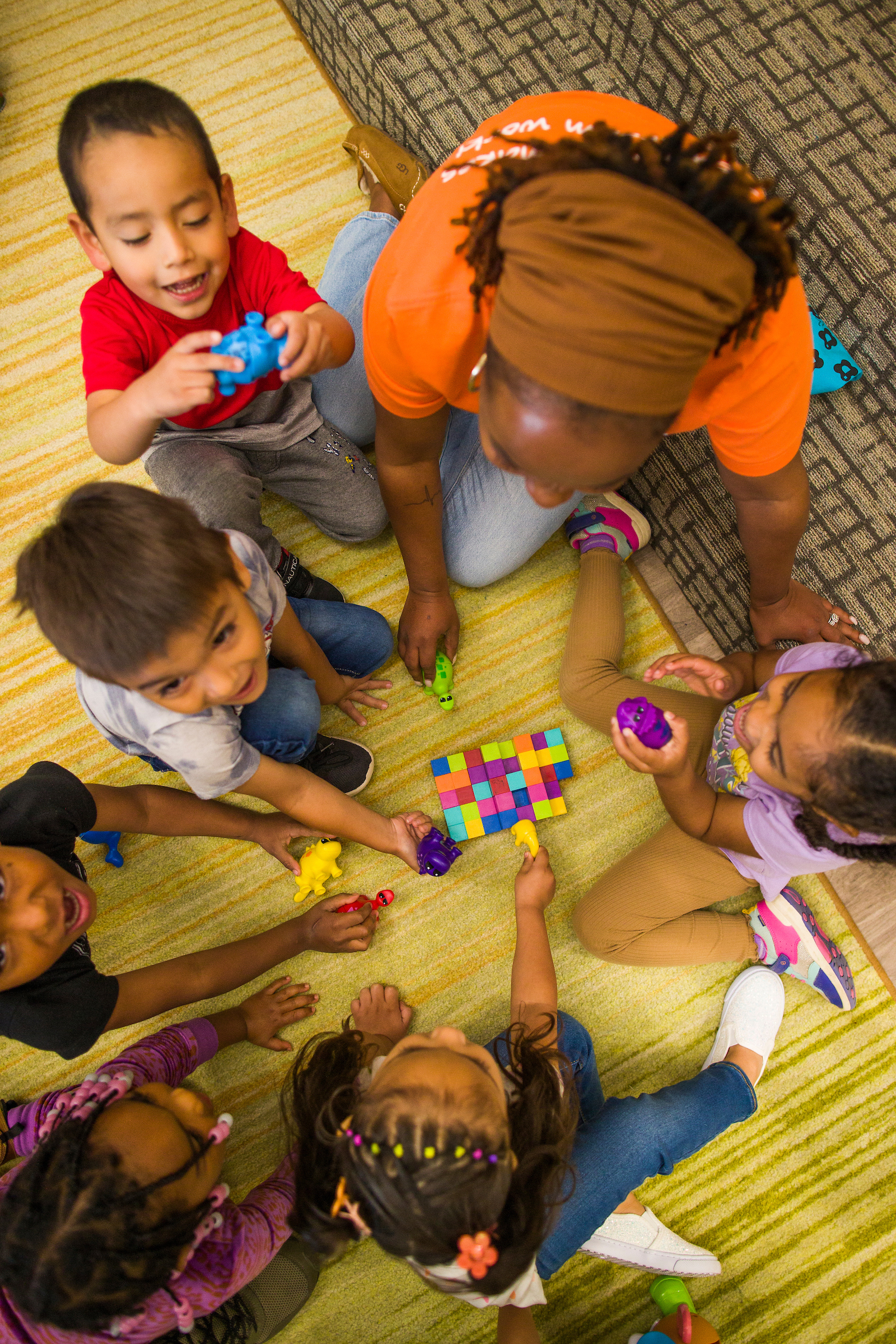
Educare schools are designed with children’s learning, family engagement and partnerships in mind. Ample physical space and light allow babies, toddlers and preschoolers to explore, learn and develop. Classrooms are safe, comfortable places that promote bonds between teaching staff, young children and their families. Spaces encourage interactive learning so that teachers and children are seen together reading, acting out stories, creating artwork, counting, or conducting simple experiments.
Inside Educare, significant space is devoted to family related activities, including one on one consulting and support groups for mothers, fathers and grandparents. There is a room with computers to facilitate parents’ efforts in job hunting, or in researching elementary schools their child will eventually attend.
Educare has a strong partnership with Tulsa Public Schools (TPS) because we both believe that every child, especially those that are at risk should have the highest quality early childhood learning environment possible. TPS began their support by donating land to Tulsa Educare to build “state of the art” early childhood facilities on the grounds of their elementary schools. The premise is that the children will receive continuity of care from birth through sixth grade, and it be a safe community campus for children and their families.
Program Quality
Tulsa Educare strives to offer high-quality, research-based services to young children from low-income backgrounds. Thus, the quality of services is important to measure and it is important to use measurement results to drive continuous program improvement.
Importantly, Tulsa Educare I – Kendall Whittier is nationally accredited by the National Association for the Education of Young Children (NAEYC) and rated as a 3 Star facility under the Oklahoma Reaching for the Stars Quality Rating System. Tulsa Educare II-Hawthorne rates as a 2 Star and is in the self study process of NAEYC Accreditation. Once confirmed, the center will automatically become three star. Oklahoma uses NAEYC as a quality rating standard and sets it as a 3 Star level, the highest standard a program can meet.
Classroom Quality
Many studies have shown that early education can produce a range of effects lasting well into adulthood, but the quality of the early childhood classroom and the interactions in that classroom are high predictors.
Many indicators that have been connected to child outcomes are fairly easy to quantify. Examples are staff-child ratios, class size, length of day and year, the credentials, experience and professional development of the teachers, and teacher turnover. The classroom quality is harder to measure. Educare uses a tool called The Classroom Assessment Scoring System (CLASS) which is an observational tool that provides a common lens and language focused on what matters—the classroom interactions that boost children’s learning. Data from CLASS observations are used to support teachers’ unique professional development needs, set organization-wide goals, and shape system-wide reform at the local, state, and national levels.
Research shows that children in classrooms with higher CLASS scores achieve at higher levels than their peers in classrooms with lower CLASS scores. The CLASS range is as follows: 1-2 Low; 3-5 Mid; 6-7 High. The chart below illustrates that Tulsa Educare has scored at the mid to high-mid in all of the subscales, which suggests that the rating is higher than other agencies using this scale as a quality rating tool.

Infant/Toddler Classrooms: In the early part of 2011, all sixteen of Tulsa Educare’s infant/toddler classrooms were rated by trained, independent observers. Educare I-Kendall Whittier, which has been opened since 2006, rated as “good” with an overall mean of 5.3 on the Infant-Toddler Environment Rating Scale (ITERS-R), a commonly used measure of global classroom quality that rates space and furnishings, personal care routines, listening and talking, activities, interaction, and program structure on a 7-point rating scale with 1=inadequate; 3=minimal; 5=good; 7=excellent. Tulsa’s infant/toddlers classrooms were able to maintain a high quality environment with data from the past four year’s ratings and the staff are to be congratulated as this level of quality is rarely found in infant/toddler programs (common scores recently reported in the literature are in the 4.0 to 5.0 range-Goelman et al., 2006; Administration for Children and Families, 2006).

The rating of the environment is used not only as a contributor to the summary rating of quality, but also as a source of detailed information about the facets of quality that need improvement and in which changes will help progress to the next quality rating.